
The Difficulty You're Escaping Was Making You
AI can lift the effort out of almost anything you find hard. Some of that effort was the thing turning you into someone.

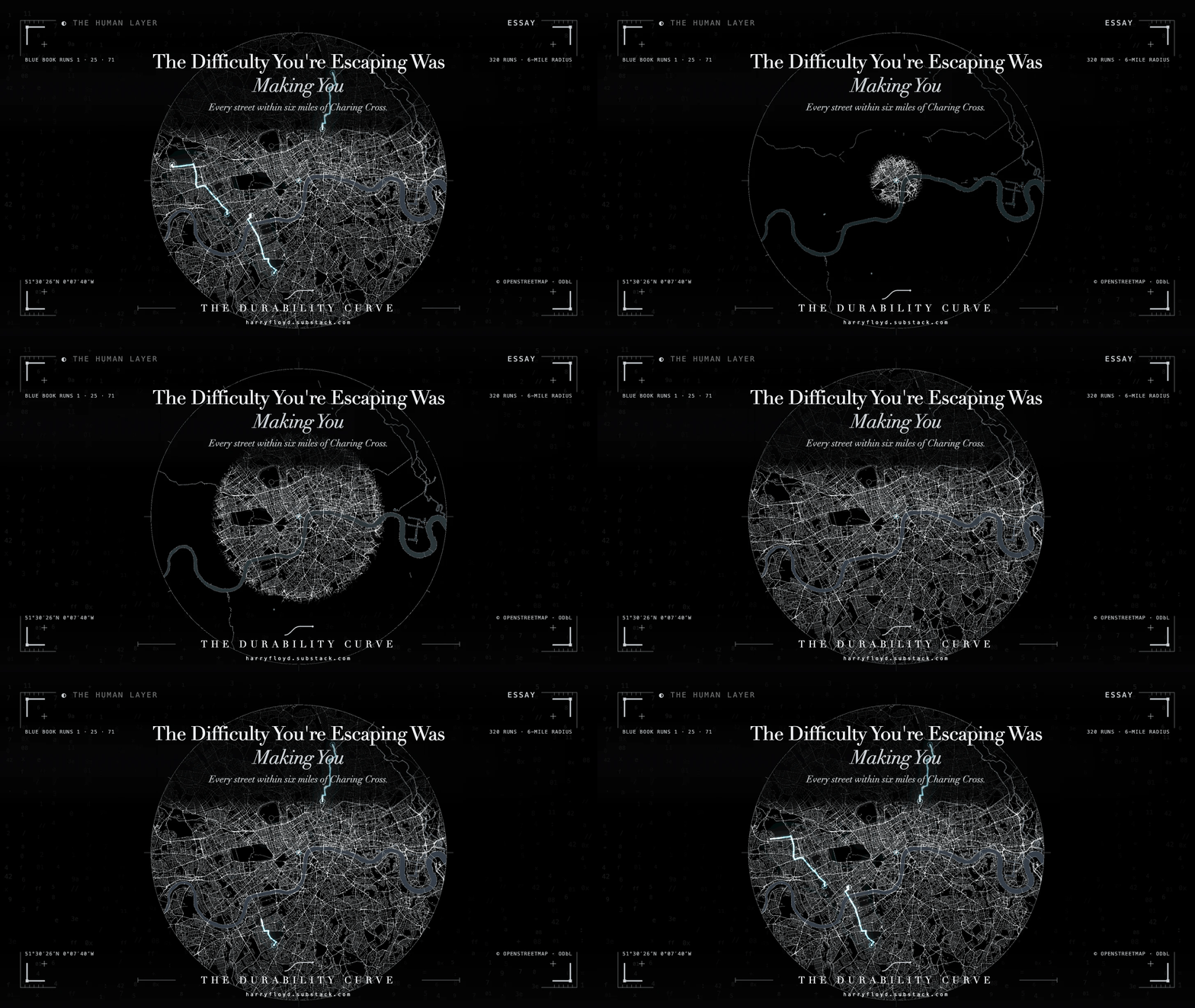
To drive a black cab in London you have to pass a test called the Knowledge. You spend three or four years on a moped in all weathers, learning every street inside roughly a six-mile circle around Charing Cross, something like twenty-five thousand streets, along with the thousands of landmarks strung between them. You learn to recite the shortest legal route between any two points in the city from memory, out loud, under questioning, with no map in front of you. Most people who start never finish. Those who make it through have spent years inside a difficulty the rest of us would pay almost anything to avoid.
Then neuroscientists put those drivers in a scanner. The part of the brain that holds a spatial map, the posterior hippocampus, was measurably larger in London cabbies than in other people, and it was larger the longer they had been driving. 1 The years had taught them the city and physically reshaped the organ that learned it. That came with a trade-off, one a later study by the same group found and almost nobody quotes: set against bus drivers, these drivers had a smaller anterior hippocampus and did worse at taking on new spatial layouts. 2 The brain had specialised, hard, to the load the years demanded, and the gain in one place sat beside a weakness in another. That is the fact to hold onto. You take the shape of what you repeatedly do the hard way.
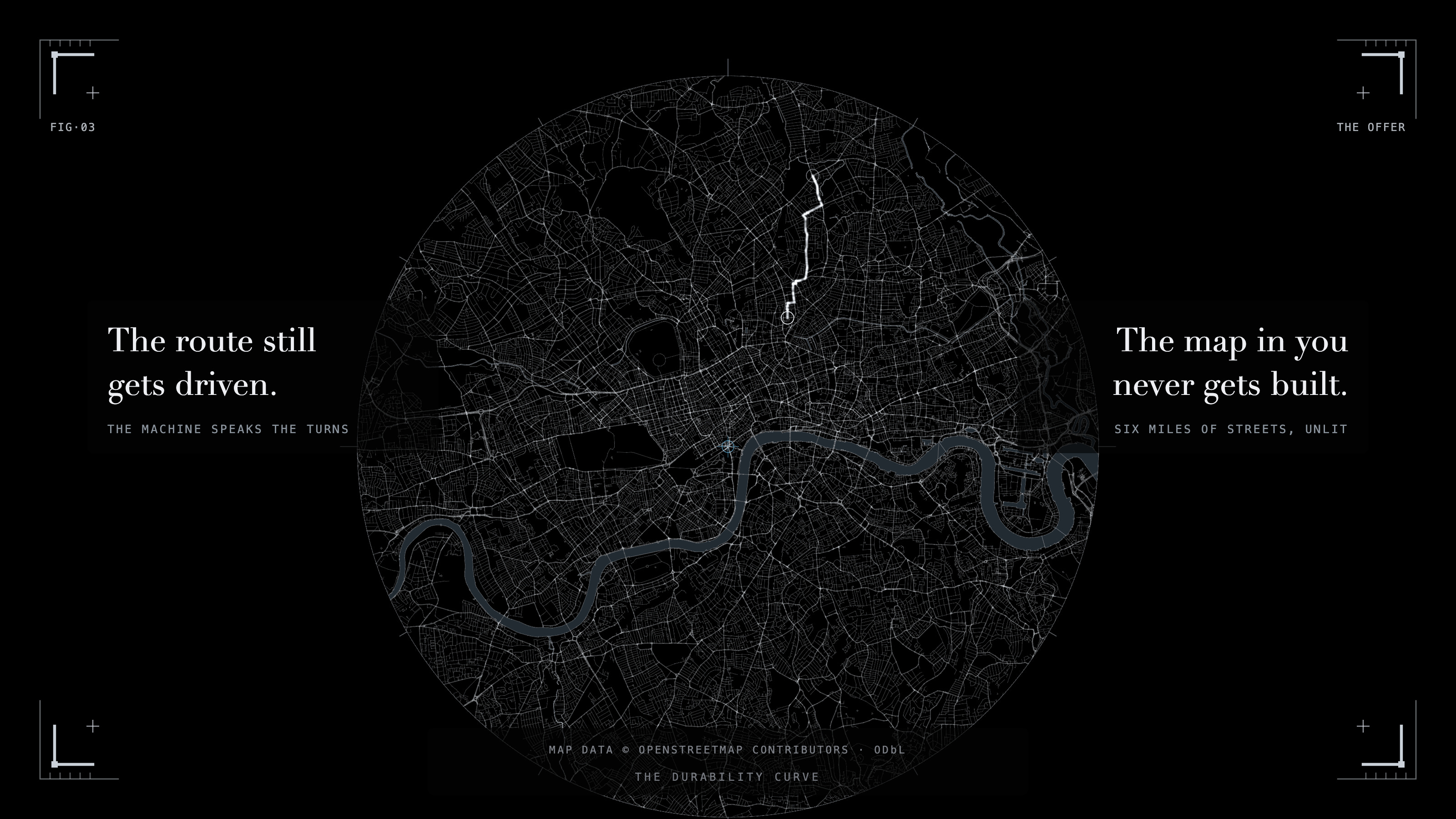
We have now built a machine that ends that strain, and not only for cabbies. A phone in a cradle speaks the turns, the Knowledge becomes unnecessary, the hippocampus never specialises, and the driver reaches the same address having built none of the map. This is not a thought experiment. When researchers followed habitual GPS users, the ones who leaned on it hardest had the worst spatial memory the moment they had to navigate on their own, and the more they used it over time, the steeper their decline. 3 Extend that same offer to nearly every effort a human used to make, and you have described the age we just walked into.
None of this worry is new. Nicholas Carr set it out twelve years ago in The Glass Cage: a skill handed to a machine quietly wastes away, and you do not notice until the day you reach for it and it is gone. 4 What has changed since is the reach of the offer, and how far up into thinking itself it now climbs.
The strain is the mechanism
You can feel a smaller version of this whenever you try to recall something you half know: the name on the tip of your tongue, the line you could almost rebuild. It feels like failure, and everything in you wants it to stop, so you look it up and learn almost nothing. The effort of hauling it back up yourself is the repetition that fixes it in memory. Reach for the answer the moment the search stalls, and what you looked up leaves no trace.
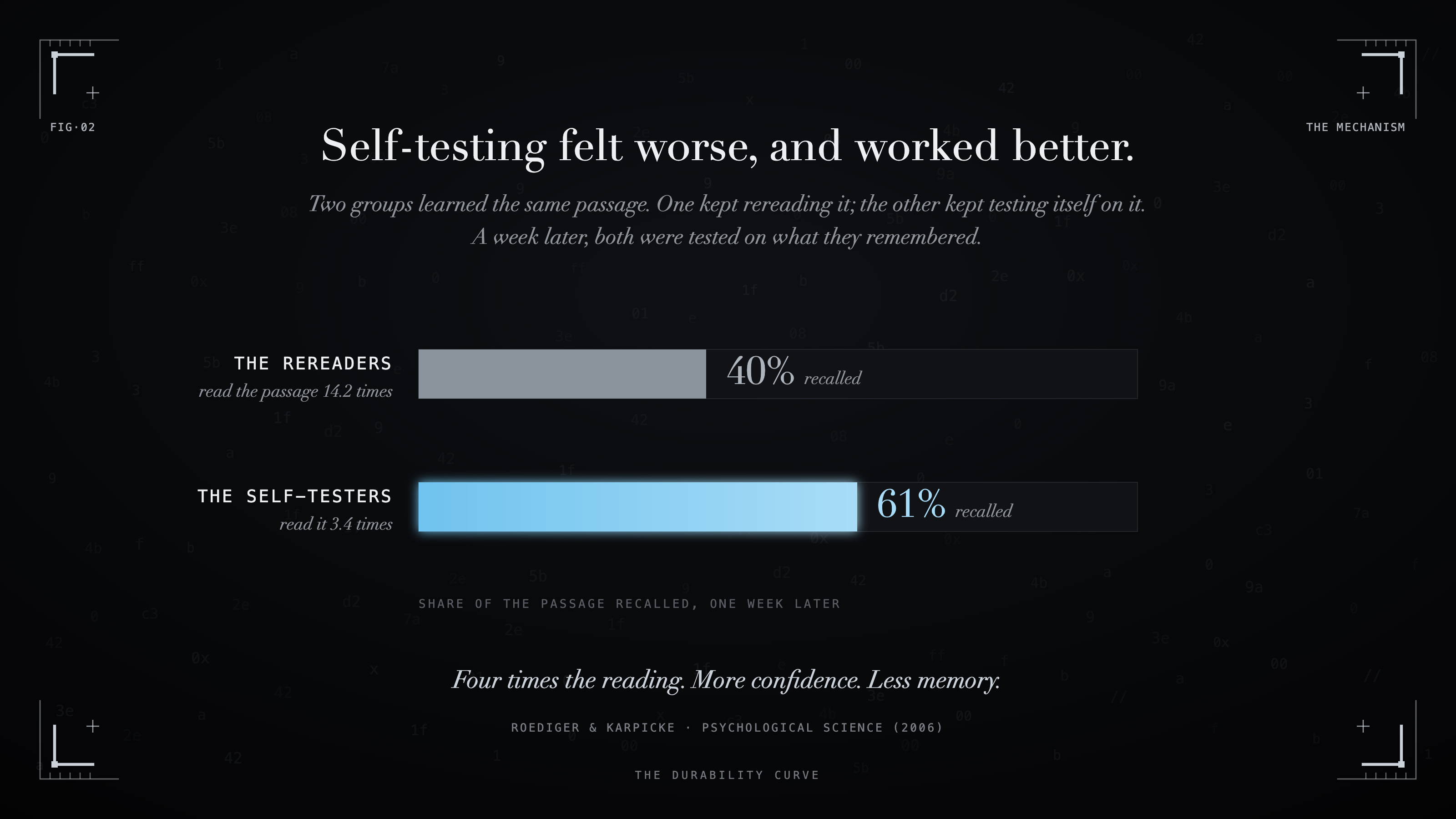
Psychologists have measured this directly. Give one group a passage to study by rereading it and another by testing themselves on it from memory, and the rereaders come away feeling they have learned more. They are wrong. On the exam a week later, the group that had to pull it back out of memory, the one that felt less certain the whole way through, remembers far more. 5
The comfortable method felt like progress and delivered little. The uncomfortable one felt like failure and did the work.
Your body speaks the same language. Muscle grows only when you load it past comfort; the pianist improves on the bars she keeps fumbling, not the ones she can already play. The effort builds; comfortable repetition only maintains.
The precision here is easy to miss, and it changes what to worry about. You do not build focus or judgement or skill in the abstract; you build close to the thing you practise, and what carries beyond it is less than we like to think. The cabbie grew the part of the brain that holds a map, and, set beside other drivers, was worse at taking on new ground. So the fear that these tools will make us dumber is too broad to act on. They make you specifically worse at whatever you hand over, and better at whatever you load in its place. That is a trade, and it can be a good one. The trouble is that nothing now forces you to put anything in its place. That turns every quiet decision to offload into more than it looks: a vote for the person you are about to become, cast without noticing you were voting.
The most tempting offer ever made
This is why what we have built is so seductive, and so easy to misread. A researcher put it better than I can: it is like we invented a cure for exercise and then wondered why we are out of breath all the time. 6 We now have a machine that will do the reaching-in-the-dark for you, write the paragraph you were straining toward, structure the argument you had not yet earned, and hand back the finished thing with the difficulty lifted out. The output looks the same. Sometimes it looks better.
You might say we have done this before and come out ahead. Writing offloaded memory. The calculator offloaded arithmetic. Nobody thinks the literate or the numerate are lesser for it. Those tools changed us too, but they took over the lower floors, the storage and the sums, and left the thinking that sat on top to us. What is arriving now reaches higher up. It can produce the visible signs of understanding, the explanation, the argument, the judgement, the finished prose, without your ever having understood the thing underneath.
None of this makes the machine the enemy; it gives a great deal. In the hands of someone already skilled it may be the most powerful lever ever built, and to a beginner with no teacher, or a striver with no way in, it hands a door that used to be locked. Which way it cuts comes down to how you aim it. Aimed at the task, it is an anaesthetic: it takes the difficulty away and hands back the result, and you keep none of what the struggle would have built. Aimed at yourself, it is a trainer: you make it argue against the case you wrote rather than write the case. You attempt the recall before you let it answer; you ask it for the harder version of the problem instead of the solution. The whole difference sits in one rule most people never follow: do not ask the machine to perform the exact act you are trying to keep. Both settings are always there, but the anaesthetic is the effortless one, so the way almost everyone drifts is the one that hollows them out.
Sometimes the output is all you want, and then you should take the help and move on. But most work makes two things, not one: the output, and the adaptation the doing leaves in you. When you write something hard, the paragraph is only the first of these. The second is that the idea you were forced to hold still long enough to say clearly is now yours in a way it was not an hour before. Let the machine write it and you keep the paragraph and never build the second thing at all. The early evidence points that way. In a controlled trial, students who researched a topic with an AI assistant remembered noticeably less of it on a later test than students who worked without one. A smaller, more preliminary study found the same shape inside the head: people who wrote with an assistant showed weaker, less connected brain activity while they worked, felt less ownership of what came out, and afterwards struggled to quote the essays they had just produced. 7
The skill you need to check the machine
There is an obvious reply to all of this, and it deserves a straight answer. If the machine does the thing well, why does it matter that you can no longer do it yourself? The cabbie with the sat-nav still arrives. The email still goes out. If the output is good, who cares which of you produced it.
Engineers ran into a version of this more than forty years ago and named it the irony of automation: hand a task to a machine and the person’s remaining job is to watch the machine and catch what it gets wrong, except that handing the task over is what wastes the skill the watching needs. 8 Most of the time we survive it, because checking a thing is usually cheaper than making it. You can offload arithmetic and keep enough number sense to feel when a total is absurd; you can read a translation you could never have written and still catch where it goes wrong. The dangerous capacities are the ones that are their own only check. Nothing smaller than judgement can tell you whether your judgement is sound. Whether an argument holds is something you feel only with the part of you that would have built it. Taste works the same way. Hand one of those capacities over and you have kept nothing cheaper to catch the failure with; the arrangement turns circular, and you need the very thing you are losing in order to know whether losing it is safe.
And the loss hides itself, which I can show you from my own desk. I write with these tools now, and because I did not fully trust what came back, I built a second layer of them to judge the first: a panel of machine readers that scores the work. They are good. They catch what I miss. But the one time I set their verdict beside a room of real readers, the machines had marked the work almost a full point higher than the people did, and every correction that mattered came from the people, not the panel. I had believed the higher number. The judgement I had handed over was certain the work was better than it was, and it had no way to know otherwise. I only found out because I asked. That is the shape of it. The danger does not arrive when the machine hands you a bad answer. It arrives when it hands you a good one, by a route that leaves you unable to recognise the next bad one. A run of good answers is not proof that you are safe; it is the very condition under which the gap stays hidden.
Meaning tracks the difficulty you choose
The cost may not stop at competence. There is a further claim here, and I will mark it as a claim: that difficulty is also where a great deal of a life’s meaning is made. Think of someone who spent a year looking after a dying parent: the broken sleep, the paperwork, the slow reversal of who holds whom. Nobody would call it easy, and almost nobody who has done it would give it back. The meaning was not in the suffering; nobody wishes the nights had been longer. It was in the commitment they kept, which had no way to show itself except by carrying the weight. Ask people for the stretches that mattered most and they rarely name the easy ones. They name the ones that cost them. Not everything that matters is earned this way, but the part of a life that feels authored, rather than merely lived, tends to be the part you had to carry. 9
That is the quiet weight of this technology. Its danger is in its success: it lifts out the difficulty that was doing the authoring, so smoothly that we thank it while some of the material a life is made from goes missing.
Not all difficulty is sacred
Here the argument could tip into a cult of pointless suffering, which is a stupid place to end up, so keep the qualification honest. Plenty of difficulty builds nothing at all. Some of it only takes. It takes your time and your patience, and hands back only the finished task, with nothing left in you to show for it. The tax form, the expense report, the twenty minutes lost to a broken interface. That kind is pure waste, and giving it to a machine is one of the real gifts of this era. Take the gift.
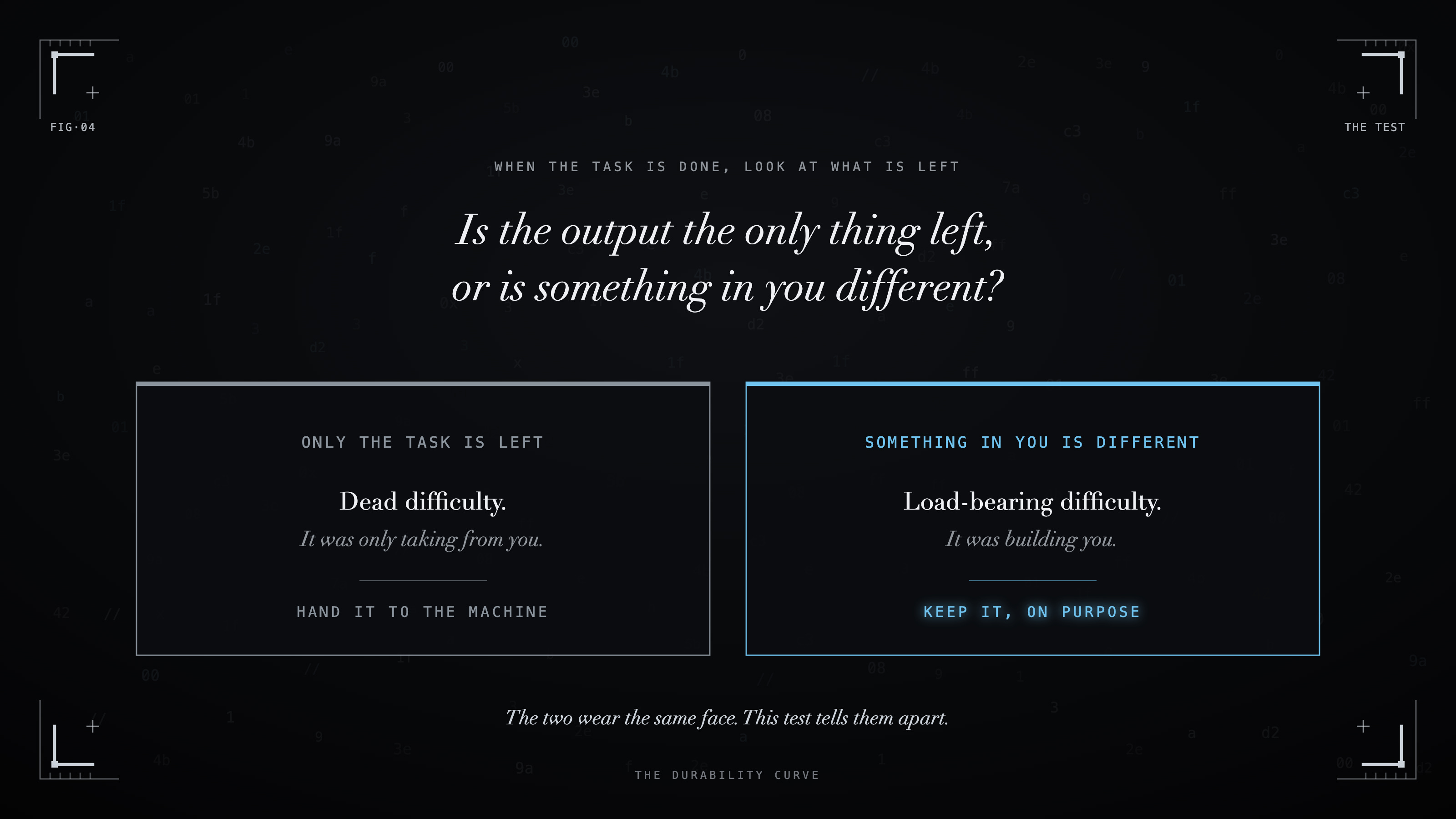
The other kind builds. It takes real effort and leaves a changed you, a capacity that stays after the task is gone. The two wear the same face, and from the inside they feel identical, both just resistance, which is why telling them apart is the whole art. One test does most of the sorting. When the task is done, look at what is left behind. If the only thing left is the finished task, that difficulty was only taking from you, and you should hand it to a machine without a second thought. If something in you is different, it was building you, and that is the one to protect.
What to do with this
So run the test on your own week. Most of the difficulty you meet is dead, and the machine should take it. But you cannot keep every difficulty that builds you either, because building one capacity tends to crowd out another, the way the cabbie’s deep map sat next to a weaker grip on new ground. You are choosing, not collecting. Protect the few capacities you want to have built: your judgement, your taste, your way of finding your way. Keep the effort that makes them, for the version of you on the far side, the one who does not exist yet. And if you doubt any of it, the claim can lose. Pick a capacity that keeps a score, one you can test cold: your way around a city, a language you used to speak, a proof you used to be able to follow. Hand its effort to a machine for a season, then reach for it. My bet is that it comes back thinner than you left it.
But notice what that test cannot reach. Judgement and taste keep no score you can read from the inside, in time; any verdict comes late, out of a decision already made, and even then you cannot tell whether your judgement slipped or the problem was simply hard. The one instrument that could read them from the inside is the one you would be handing over. I am not asking you to keep them because the loss cannot be proved. I am asking you to look at the odds, and they are not close: in every case we can actually measure, from navigation to memory to the skills automation has quietly taken, the effect is real, and judgement is not a safe bet to be the exception. For a capacity you have chosen to protect, keep the effort, and the worst case is that you did some work a machine could have done. Hand it over, and the worst case is that you find out what you lost at the moment you need it, and can no longer rebuild it.
The cabbies had one advantage we will not. They chose the job, but not the difficulty inside it: if they wanted the badge, the city made the years compulsory, and there was no way to skip them. No institution will impose ours. That is the danger, and it is also the opening. What ends, in a world like that, is formation by default: nothing outside you will build you any more unless you choose to keep it, so more and more of what you can still do in ten years will be what you deliberately kept practising. The cabbies were made by a difficulty they were handed. We get the harder, better thing: to choose what makes us, and to become, in a world going frictionless, someone made by what they chose to keep.
Which difficulty will you keep doing the hard way, now that so little makes you?
Two studies of London taxi drivers by Eleanor Maguire's group at University College London. Cross-sectionally, Eleanor A. Maguire et al., "Navigation-Related Structural Change in the Hippocampi of Taxi Drivers," Proceedings of the National Academy of Sciences 97, no. 8 (2000): 4398–4403, found greater posterior hippocampal grey matter in licensed drivers than in controls, correlated with years of experience. Longitudinally, Katherine Woollett and Eleanor A. Maguire, "Acquiring 'the Knowledge' of London's Layout Drives Structural Brain Changes," Current Biology 21, no. 24 (2011): 2109–2114, found that trainees who qualified gained posterior grey matter over three to four years while those who failed and non-drivers did not, which licenses reading the change as produced by the training.
Eleanor A. Maguire, Katherine Woollett, and Hugo J. Spiers, "London Taxi Drivers and Bus Drivers: A Structural MRI and Neuropsychological Analysis," Hippocampus 16, no. 12 (2006): 1091–1101. Compared with bus drivers, taxi drivers had more grey matter in the posterior hippocampus and less in the anterior, and did worse on tests of new visuo-spatial learning. The comparison is cross-sectional, so the smaller anterior volume is a difference between groups rather than a measured within-person loss; the causal reading of the posterior growth rests on the longitudinal study in the previous note.
Louisa Dahmani and Véronique D. Bohbot, "Habitual Use of GPS Negatively Impacts Spatial Memory During Self-Guided Navigation," Scientific Reports 10 (2020): 6310. Across fifty adults, heavier lifetime GPS use was associated with worse spatial memory during unaided navigation, and a follow-up found that greater use over the intervening period predicted a steeper decline. The design is correlational and cannot fully exclude weaker navigators relying on GPS more, though the longitudinal arm points toward the habit contributing to the loss.
Nicholas Carr, The Glass Cage: Automation and Us (New York: W. W. Norton, 2014). Carr argues that automating a task erodes the underlying human skill, and that the deficit stays hidden until the skill is called on again, drawing on cockpit automation and satellite navigation. The argument here builds on his, adding that the loss is specific to whatever is handed over and proposing a test for which difficulties are worth keeping.
Henry L. Roediger III and Jeffrey D. Karpicke, "Test-Enhanced Learning: Taking Memory Tests Improves Long-Term Retention," Psychological Science 17, no. 3 (2006): 249–255. Retrieval practice produced markedly better week-later retention than repeated study, even as repeated study produced greater confidence along the way. The wider framing is Robert A. Bjork's "desirable difficulties": the difficulty must be of a kind that effortful encoding or retrieval rewards, not difficulty for its own sake.
Advait Sarkar, "How to Stop AI from Killing Your Critical Thinking," TEDAI Vienna, 26 September 2025. The quoted line is his: "It's like we invented a cure for exercise and then wondered why we're out of breath all the time." His argument is that tools which remove mental effort atrophy the cognitive capacities they were meant to serve.
Two strands of early evidence, the sturdier first. André Barcaui, "ChatGPT as a Cognitive Crutch: Evidence from a Randomized Controlled Trial on Knowledge Retention," Social Sciences & Humanities Open (2025). In the trial, 120 undergraduates researched a topic using either ChatGPT or conventional methods, and the ChatGPT group later scored 57.5% on a retention test against 68.5% for the others (Cohen's d = 0.68). More preliminary is Nataliya Kosmyna et al., "Your Brain on ChatGPT: Accumulation of Cognitive Debt When Using an AI Assistant for Essay Writing Task," arXiv:2506.08872 (2025), a small, non-peer-reviewed study in which participants who wrote with a large language model showed the weakest EEG connectivity of three groups, the lowest reported ownership of their essays, and the worst recall of what they had just written; treat it as suggestive rather than settled.
Lisanne Bainbridge, "Ironies of Automation," Automatica 19, no. 6 (1983): 775–779. Writing about industrial control rooms, Bainbridge observed that automation leaves the operator to monitor the machine and catch its failures while removing the hands-on practice that built the skill the monitoring requires. The essay carries that paradox up into cognitive work, where the capacity being automated is increasingly judgement itself.
Matthew B. Crawford, Shop Class as Soulcraft: An Inquiry into the Value of Work (New York: Penguin Press, 2009), and The World Beyond Your Head: On Becoming an Individual in an Age of Distraction (New York: Farrar, Straus and Giroux, 2015). Crawford argues that agency and selfhood are formed by submitting to a reality that resists us and is not of our making. The claim here that a life feels authored in proportion to what it demanded is his; this essay approaches it from the opposite side, through what is lost when the resistance is removed.
Your test is exact: when the task is done, look at what is left behind. That test has a structural formalization.
A constituting entity operates within an admissibility band. Perturbation within the band is absorbed: the entity flexes, adapts, strengthens. The band widens. The cabbie's posterior hippocampus growing over four years IS the band widening through sustained perturbation. The flex IS the learning. The learning IS the structural change.
Remove the perturbation and the band narrows through disuse. The GPS user's spatial memory declining IS the band narrowing. The student who used ChatGPT scoring 57.5% against 68.5% IS the band narrowing. The narrowing is not a judgment. The narrowing is a structural observation: the range within which the entity can absorb perturbation contracted because nothing perturbed it.
Your two kinds of difficulty map to two regions of the gradient. Waste difficulty (the tax form, the broken interface) is perturbation that produces no flex. The entity absorbs it but nothing widens. The perturbation was friction, not structure. Building difficulty (the argument you forced yourself to hold still, the city you learned street by street) is perturbation that produces flex. The entity absorbs it and the band widens. The entity IS different after.
The dangerous part is the one you named: judgement is its own only check. You cannot hand judgement to the machine and keep a cheaper instrument to verify the machine's judgement, because the only instrument that could verify it is the judgement you just handed over. The verification loop is circular. The circularity IS the structural reason the loss hides itself. The band narrowed. Nothing in the narrower band can detect that it narrowed. The detection requires the wider band that no longer exists.
Really interesting piece. Difficulty isn’t the obstacle rather it’s how we build value.
Calculators and GPS made life easier, but we still learned the fundamentals before relying on them. AI feels different because it can step into any layer right from thinking to execution.
The challenge is making sure we use AI to enhance our judgment and remove only friction, not replace the productive struggle that helps us develop it.