
The Displacement Rate Audit
A ten-minute instrument for any product, position, architecture, or business model. Score what still works after the environment changes.

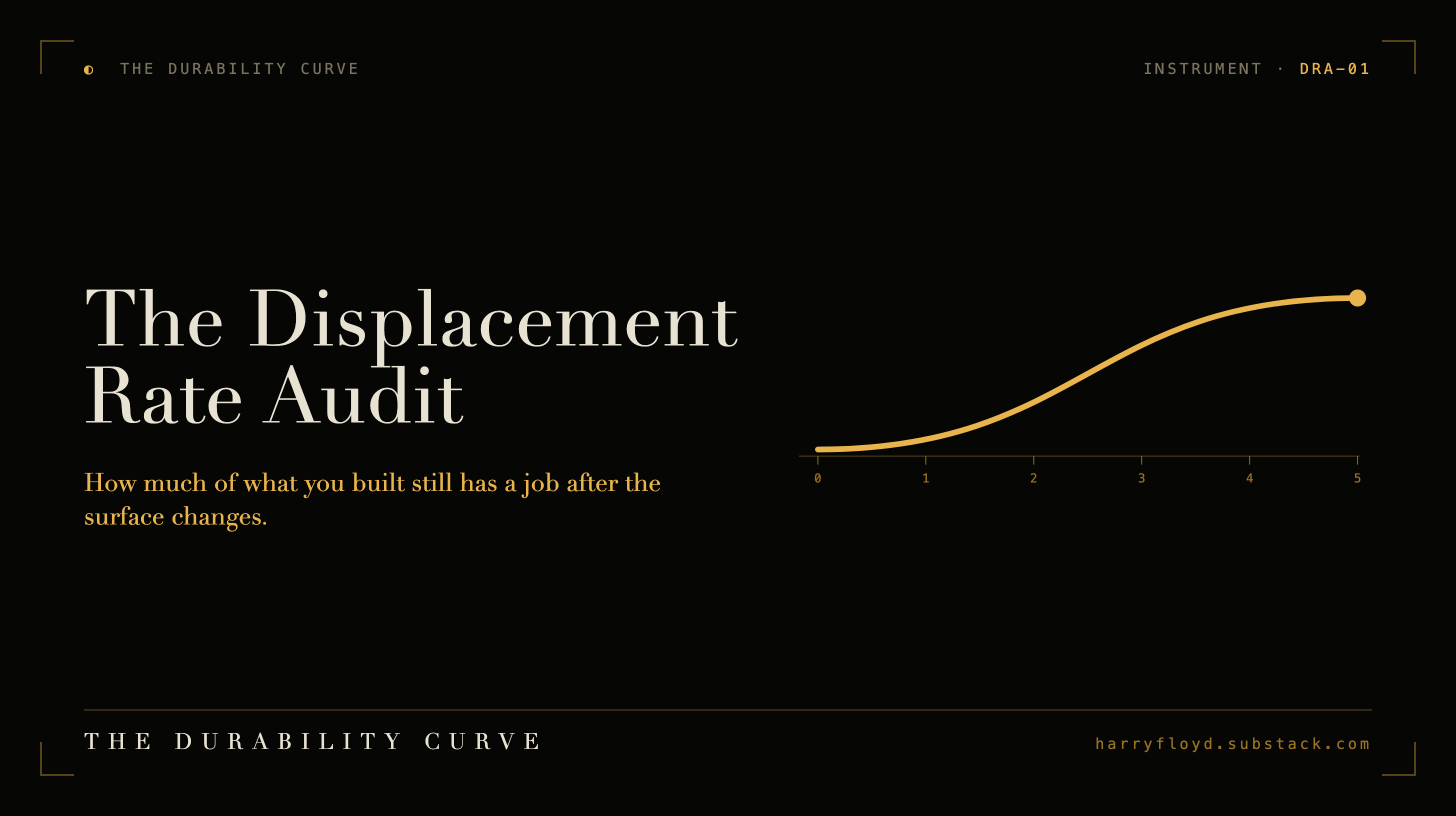
Most plans are scored against the world they were made in.
That is the problem.
The question worth asking is how much of what you have built still has a job once the surroundings change. It measures durability under a named disturbance, before reality runs the test for you.
The Displacement Rate Audit is a free instrument for doing exactly that, in about ten minutes, on one thing you are currently defending: a product line, an investment thesis, a technical architecture, or a career bet. It works in three steps.
Name the change. Pick the single most likely large change in the next eighteen months. The audit only works if the change is specific enough to argue with. “AI gets better” is too vague. These are concrete enough:
An open-source model matches your benchmark and runs on commodity hardware.
Your sector takes thirty percent multiple compression.
Your main distribution channel stops favouring your format.
The buyer no longer needs the workflow your product was built around.
Build the score. Break the thing into its load-bearing parts and judge each one against that change: what survives, what is only partly safe, what dies. The 0-5 displacement score falls out of the pattern. Zero means nothing survives; the work belonged to the old version of reality. Five means the change was already accounted for in the original design.
Prove yourself wrong. Name the one observation in the next quarter that would force the score down a tier. This is the forcing function, and it is the whole point:
If you cannot name the specific components, contracts, positions, and relationships that still have a job after the change, your real score is lower than the one you wrote.
The tool measures one thing: whether the work is durable under a named disturbance. That is why it travels across domains, from product lines to positions to architectures.
The output is deliberately small: one named change, one score, and one list of the parts that survive. Enough to make the next decision harder to fake. Use it before adding features, before sizing a position, before doubling down on an architecture, and when a strategy still sounds good but you can feel the surroundings moving.
Download the instrument.
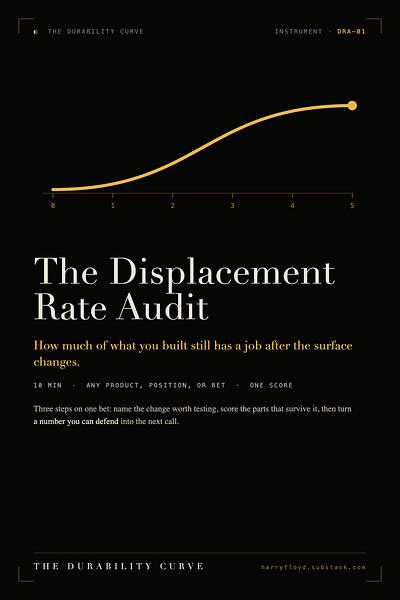
More free tools like this. Subscribe to get the next durability-lens resource the day it ships.
The Displacement Rate Audit is a companion to The Forest Floor Is the Product, the article that develops the substrate-vs-canopy lens across ecosystems, software, knowledge work, and capital allocation.
What is one thing you are building that would score lower than you want if the next big change arrived tomorrow?