
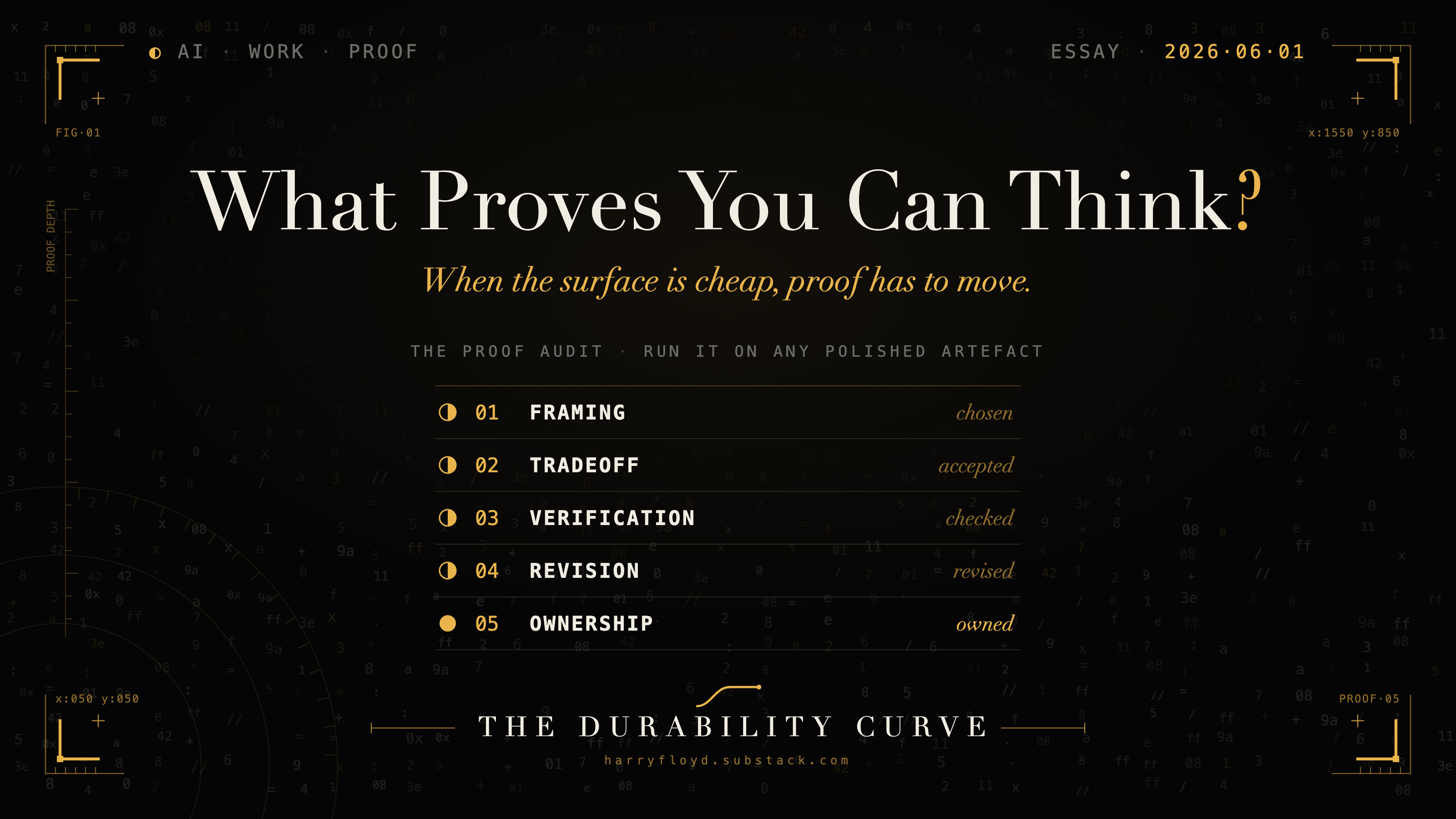
What Proves You Can Think?
When anyone can generate the polished answer, the proof of thinking moves to the judgement behind it.

The private question under the public panic
The question people ask in public is usually safer than the one they are carrying.
In public, they ask whether AI will take their job.
That is a real question. It matters. People have mortgages, families, obligations, and a private picture of what the next ten years were supposed to look like.
But the job question is not the whole wound.
Underneath it is something harder to say:
If the work no longer proves I can think, what does?
That is the nerve.
It has little to do with productivity, prompting, or tool fluency. It is not really about whether the latest model can build a deck, write working code, or draft a strategy faster than you can read this sentence.
The deeper disturbance is that the visible artefact has become a weaker signal.
A polished answer used to imply that someone had wrestled with the problem. Not perfectly. People have always bluffed, copied, exaggerated, and decorated weak thinking with confident prose. But effort left traces. If a memo was clear, maybe someone had done the reading. If a portfolio was strong, maybe the person had taste. If a student essay was coherent, maybe the student understood the material. If a candidate wrote a thoughtful cover letter, maybe they had thought about the role. If a junior analyst built a clean model, maybe they had earned some trust.
The artefact was never proof.
But it was evidence.
AI weakens that evidence. It does not erase it, but it changes what the evidence means. The surface can now arrive without the struggle that used to give the surface some weight.
That is why the anxiety feels larger than a labour-market forecast.
People are not only afraid that machines will do tasks. They are afraid that the old ways of proving themselves will stop working.
The old proof contract
Every institution runs on proof contracts.
A school asks for essays, exams, projects, and degrees. A company asks for CVs, interviews, work samples, and performance reviews. A market asks for traction, revenue, retention, and reputation. A publication asks for essays, taste, consistency, and a visible record of judgement.
None of these signals are pure. They are all compromises.
The CV was always a marketing document. The essay was always a partial view of understanding. The interview was always distorted by nerves, charm, preparation, status, and bias. The portfolio could hide how much help the person had. The degree could compress years of uneven learning into a brand name. The performance review could reward politics as much as contribution.
Still, these signals worked well enough to coordinate around.
They worked because many polished surfaces were costly to produce. You could fake some of them some of the time, but not all of them without effort, context, relationships, and repeated exposure. Cost created friction. Friction created signal.
That was the old proof contract:
The artefact is not the ability, but it is expensive enough to be treated as evidence.
AI attacks the “expensive enough” part.
It does this unevenly. Plenty of work stays hard. Skill gaps between people are as real as they ever were. Domain knowledge, taste, context, and accountability still matter.
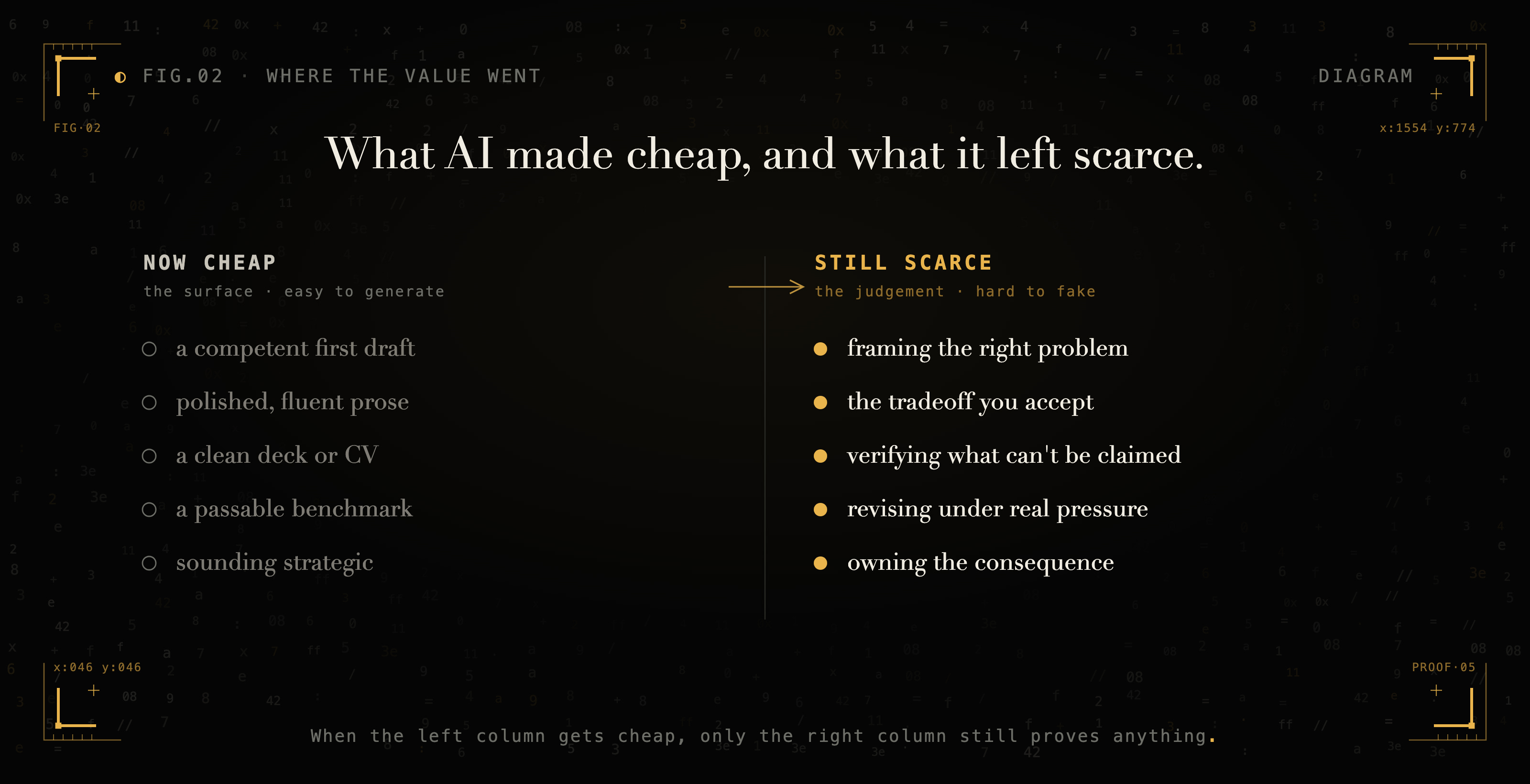
What it compresses is the cost of appearing competent.
That is enough to break a lot of systems.
If the cost of producing a competent-looking first draft falls, the first draft stops proving what it used to prove. If the cost of sounding strategic falls, strategic prose becomes less informative. If the cost of producing a clean application falls, hiring teams receive more polished noise. If the cost of generating an essay falls, readers and schools learn to distrust the shape of polish itself.
The collapse is not that nobody can think anymore.
The collapse is that the old proxy no longer tells us who can.
Why the anxiety is rational
This is why “adapt” often lands badly.
It sounds sensible from far away. Use the tools. Learn faster. Become more productive. Move up the value chain. Let AI do the routine work and focus on judgement.
Much of that is correct.
It is also incomplete.
If someone’s fear is only that their task list will change, “adapt” is an answer. If their fear is that the proof system around their competence is dissolving, “adapt” can sound like a refusal to look at the loss.
A 2026 Frontiers in Psychology paper analysed 1,454 Reddit narratives about AI-driven job displacement. Its authors describe “algorithmic anxiety” not simply as fear of job loss, but as a broader disruption to the workplace psychological contract. The themes they identify include shattered trust, eroded professional identities, devalued expertise, and a creeping cynicism about whether adapting is even possible. 1
That list matters because it names the real object.
People are not responding to a tool in isolation. They are responding to a breach in the bargain. Work was supposed to do more than produce income. It was supposed to provide status, identity, proof, and a story about becoming more capable over time.
AI does not need to eliminate a job to disturb that story.
It only needs to make the proof ambiguous.
If your hard-won expertise can be imitated at the surface by someone with less experience, the insult is not only economic. It is epistemic. The world can no longer see the difference as easily.
If your manager cannot distinguish your judgement from AI-polished output, your value becomes harder to defend.
If your school cannot tell whether a student understood the assignment or generated a plausible response, assessment becomes theatre.
If your hiring process cannot distinguish a candidate who can think from a candidate who can prompt a passable application, the CV pile becomes less like a talent market and more like a noise machine.
The nervous system understands this before the policy memo does.
The old proof objects are getting weaker.
The new proof objects have not yet been built.
Output is moving down the stack
The mistake is to treat this as a content problem.
Too many AI debates still ask whether the output is good. Is the essay coherent? Is the code functional? Is the answer accurate? Is the image impressive? Is the analysis plausible? Did the model pass the benchmark?
Those questions matter, but they sit too low in the stack.
When output gets cheap, output quality becomes the opening bid, not the final proof.
The important question moves upward:
What does this output prove about the person, team, or system behind it?
Sometimes the answer is: not much.
A clean memo may prove that someone had access to a strong model and enough taste not to paste the first result. A polished deck may prove that the organisation has a presentation machine. A strong CV may prove that the candidate knows how hiring filters work. A synthetic benchmark score may prove that the model, harness, prompt, evaluator, and task distribution aligned for that run.
None of that is worthless.
But it is thinner proof than people want it to be.
The surface is becoming a commodity layer. It can still matter because surfaces are how humans encounter work. Customers need interfaces. Readers need sentences. Managers need summaries. Recruiters need packets. Teachers need submissions. Investors need decks. Teams need artefacts they can move around.
The surface is not dead.
It is demoted.
It no longer sits at the top of the proof hierarchy. It becomes the thing you inspect after asking what kind of judgement produced it and what kind of accountability stands behind it.
The proof must move upward
The next proof system will not ask only whether you produced a good artefact.
It will ask what happened before, during, and after the artefact.
Before the artefact, it will ask whether you framed the right problem. Did you name the constraint that mattered? Did you reject the easy but wrong brief? Did you understand the regime you were in? Did you decide what not to optimise?
During the artefact, it will ask how you worked with the machine. Did you use AI to explore options or to avoid thinking? Did you notice when the answer was overconfident? Did you check the parts where the model is most likely to bluff? Did you preserve the reasoning that matters, or only the final surface?
After the artefact, it will ask what survived contact with reality. Did the code run under production constraints? Did the strategy change a decision? Did the essay make a reader see differently? Did the hire perform after the interview? Did the student defend the argument without the draft in front of them? Did the model output hold up under a verifier that was not designed by the same optimism that generated it?
This is the move:
Proof shifts from artefact to trace, from answer to framing, from fluency to revision, from claim to consequence, from ownership of output to ownership of judgement.
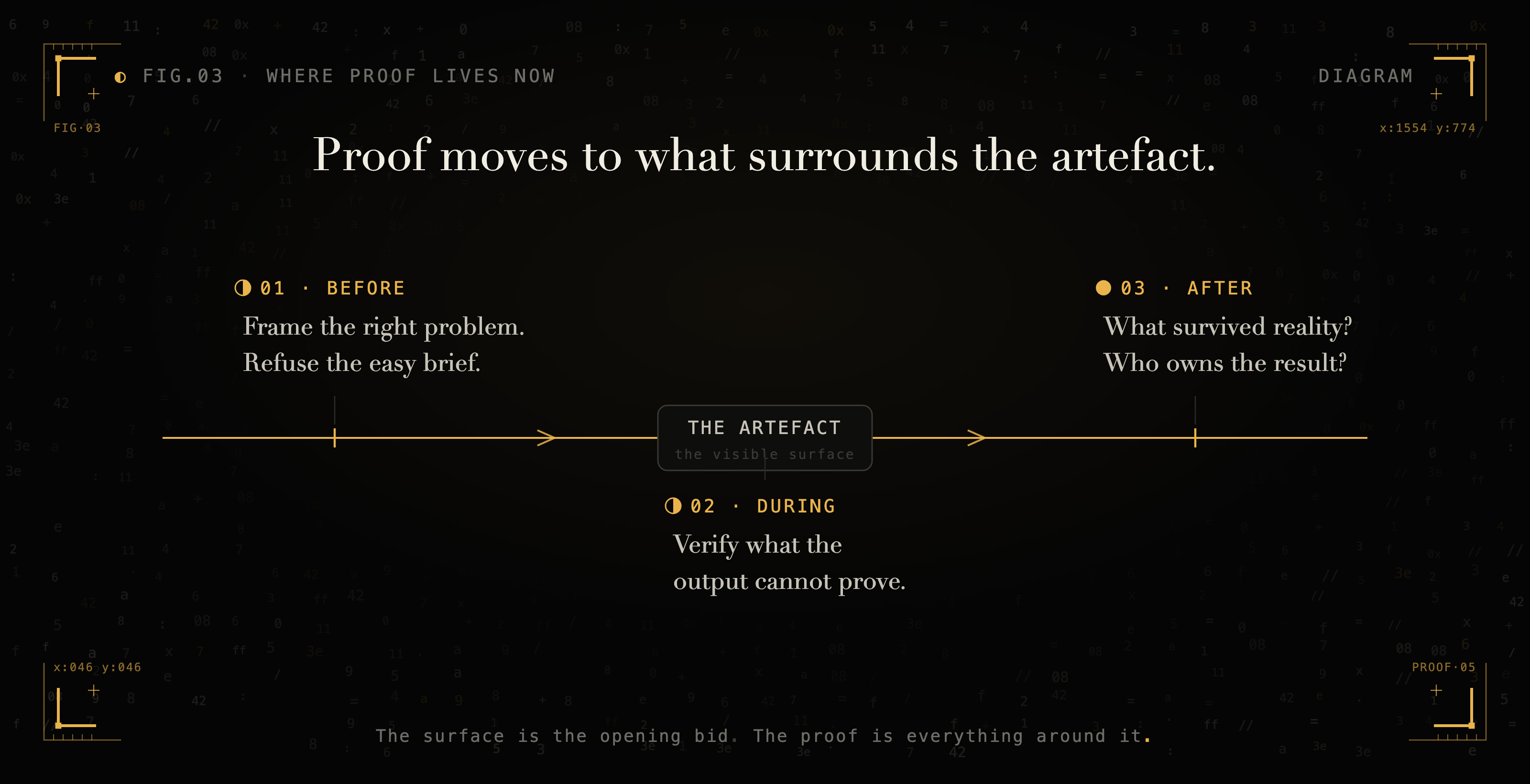
Proof moves to what surrounds the artefact. The visible surface is the opening bid; the proof is what comes before, during, and after it.
That shift changes nearly everything.
It changes hiring. A work sample is no longer enough. The stronger signal is an audit interview where the candidate critiques an AI-generated answer, names what would break in production, and explains the tradeoff they would accept.
It changes education. An essay is no longer enough. The stronger signal is an oral defence, a revision history, a live problem-framing exercise, or a student’s ability to explain why they rejected a tempting but false argument.
It changes management. A completed task is no longer enough. The stronger signal is whether the person can tell you what they froze, what they allowed to vary, what risk they accepted, and what evidence would make them change course.
It changes content. A polished article is no longer enough. The stronger signal is whether the writer has a world, a lens, a record of judgement, and the ability to produce instruments that readers can use.
It changes self-respect. A finished thing is no longer enough to prove to yourself that you were present. The stronger signal is whether you can stand behind the choices that made it.
The five proof questions
The useful response is not to ban AI from proof.
That would be brittle. It would also miss the point. A person who can use AI well, verify its work, and carry responsibility for the result may be more valuable than someone who refuses the tool out of status anxiety.
The right response is to stop treating AI-polished output as the proof object.
When you need to know whether something is real, ask five questions.
What problem was chosen, and what easier problem was rejected?
This is the first proof of thought. Bad work often begins with accepting the first fluent frame. Good work usually contains a buried refusal. Someone saw the tempting version of the problem and did not take it.
What tradeoff was made under constraint?
Intelligence becomes visible at the boundary. Anyone can say they value quality, speed, safety, originality, and user experience. Real judgement appears when not all of them can be maximised at once.
What did the person or system check that the output itself could not prove?
This is the verification question. It separates people who use AI as a generator from people who use AI inside a judgement loop. The output can say it is correct. That is not verification. Verification is the external thing that makes the claim answerable.
What changed after feedback, failure, or contact with reality?
Revision is underrated because it is less glamorous than creation. But in an AI world, revision becomes a higher-status signal. The first surface is cheap. The changed surface after friction is where more truth appears.
Who owns the consequence if this is wrong?
Accountability is the signal machines cannot carry in the human sense. A model can produce. A person, team, school, company, or institution must decide what it is willing to stand behind.
These questions are not a philosophy exercise.
They are a working instrument.
Use them on a CV. Use them on a student essay. Use them on an AI-generated strategy. Use them on your own work before you publish, hire, fund, or deploy.
If the artefact cannot answer any of them, it may still be useful.
But it is weak proof.
The new elite signal
The people who win in this environment will not be the people who produce the most surfaces.
They will be the people whose judgement remains visible after the surface becomes easy.
That is a different game.
It rewards those who can frame problems before generating answers. It rewards those who can make verification part of the work instead of an afterthought. It rewards those who can revise under pressure without collapsing into defensiveness. It rewards those who can explain tradeoffs plainly. It rewards those who can hold an accountability line when the output is impressive but the evidence is thin.
It also punishes a lot of institutions.
Schools that keep grading the artefact as if the artefact still means what it meant in 2019 will train students into theatre. Companies that keep filtering for polished applications will drown in polished applications. Managers who reward visible productivity without inspecting judgement will build teams that look busy and become fragile. Publications that chase more output without a recognisable proof of taste will become part of the slop layer they complain about.
The world does not need fewer artefacts.
It needs better proof around artefacts.
A new category opens here. Call it proof design: building the signals that still mean something when the surface costs almost nothing to produce.
The exhausted takes all miss it. Optimism and doom argue about whether the tools are good. “Learn the tools” and “humans are still special” argue about who survives. The more useful question sits to the side of all four. What evidence of judgement holds up after the artefact becomes cheap?
That is the work now.
What to do with this
Run a one-week proof audit.
Pick three places where polished output is currently being treated as evidence of thought: a CV screen, a student submission, a strategy memo, or one of your own public posts.
For each one, ask what proof would still survive if the surface had been generated. If the answer is “not much,” do not throw the artefact away. Move the proof upward. Add the framing, the tradeoff, the verification, the revision, or the accountability line.
If you are a worker, stop trying to prove value only through polish. Keep the polish, but attach judgement to it. Show the problem you chose. Show the tradeoff. Show the verification. Show the revision. Show what you will own.
If you are hiring, stop asking only for artefacts. Ask candidates to audit artefacts. Give them a plausible AI-generated answer and ask what is wrong, what is missing, what would fail in the real environment, and what they would check before trusting it.
If you are teaching, stop treating AI use as the centre of the problem. The deeper problem is whether your assessment still proves learning. If the submission can be generated, move proof into defence, revision, transfer, and live explanation.
If you are building a company, stop confusing generated velocity with institutional learning. Your system can spin up endless plans, experiments, and dashboards. The signal that matters is what proof gets stronger each time it runs.
If you are creating in public, stop assuming people will trust you because the output is polished. Build a visible record of judgement. Make your lenses repeatable. Make your standards legible. Let readers see that something underneath the surface is doing the work.
The old proof contract is not coming back.
That does not mean thinking stops mattering.
It means thinking has to leave different evidence.
The next time you look at a polished piece of work, do not ask only whether it is good.
Ask what it proves.
Ask what it hides.
Ask what pressure it survived.
Ask who can defend it when the model is gone, the prompt is gone, the screenshot is gone, and the only thing left is the decision someone chose to stand behind.
That is where competence moves.
Not into the surface.
Into the proof beneath it.
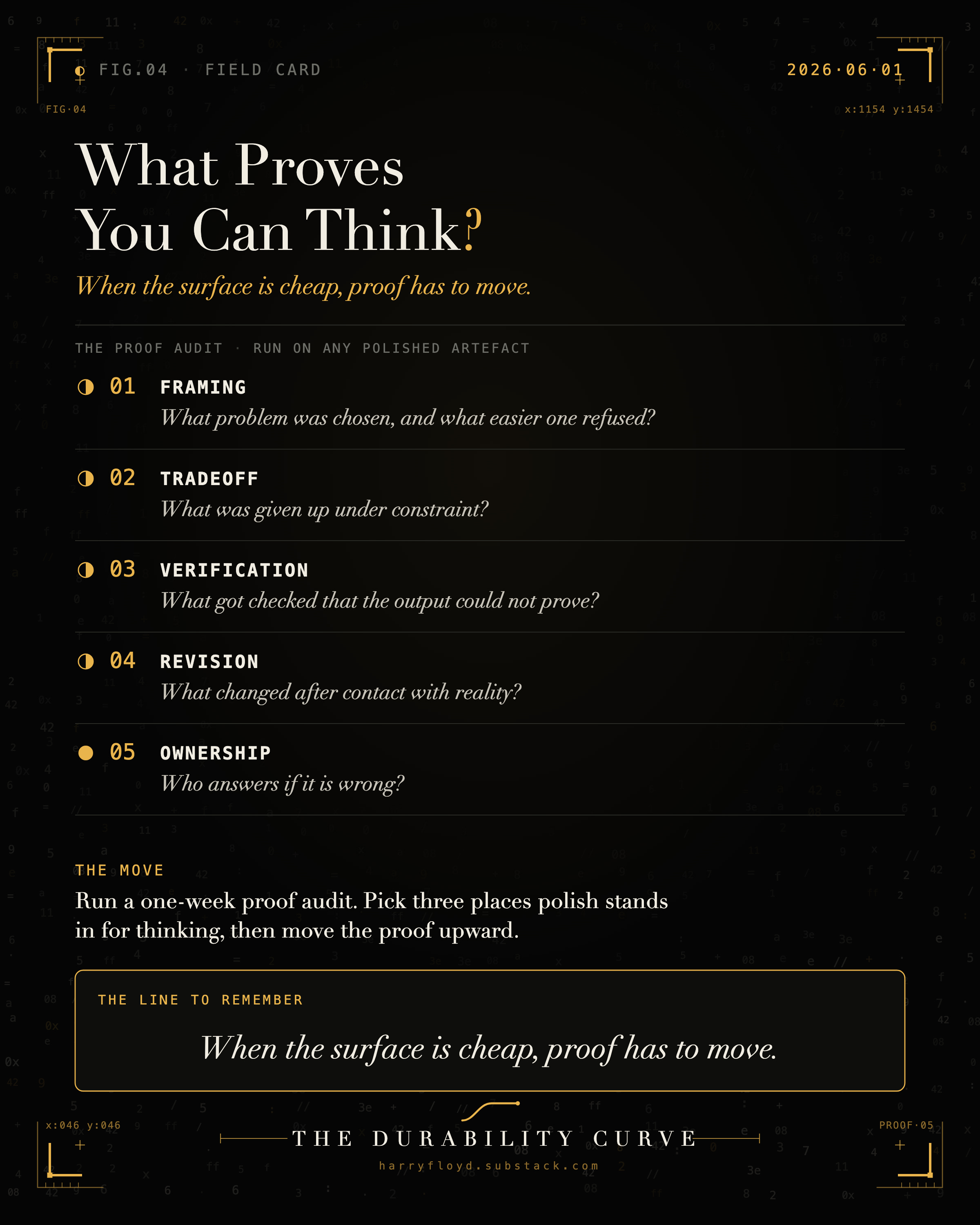
Save the card. Run the five questions on the next polished thing that lands on your desk.
If this frame lands, the practical question is: where in your work are you still using polished output as proof of thought?
The Durability Curve is a standing argument about what lasts when the surface gets cheap. Proof design is where it goes next. Subscribe for the rest of it.
New here? Start with what survives, or take the reader tools with you.
Anurag Shekhar and Musawenkosi D. Saurombe, “Algorithmic anxiety: AI, work, and the evolving psychological contract in digital discourse,” Frontiers in Psychology, 17 February 2026. The paper reports a mixed-methods analysis of 1,454 Reddit narratives about AI-driven job displacement and identifies themes including shattered trust, eroded identities, technostress, devalued expertise, anxiety about the future, cynicism about adapting, and affirming human values. https://doi.org/10.3389/fpsyg.2026.1745164