
Your Multi-Agent System Is an Org Chart
Cognition said don't build them. Anthropic said do. A year on, they converge on the one question that decides it.

You ask an agent to build a Flappy Bird clone. It looks like a job you can split, so you split it. One sub-agent gets “build the moving background with green pipes and hit boxes.” Another gets “build a bird the player can move up and down.” Two workers, two clean tasks, run them at once.
The first sub-agent builds a background that looks like Super Mario Bros. The second builds a bird that is not shaped like a game asset and moves nothing like the one in Flappy Bird. Now a third agent has to glue two misunderstandings into one game.
So you fix the obvious thing. You hand each sub-agent the full original task, not just its slice. Run it again. This time the pipes and the bird are both recognisably Flappy Bird, and they are drawn in two completely different visual styles, because neither sub-agent could see what the other was making.
That is the default failure of the architecture most teams reach for first, and the reason has nothing to do with the model you picked.
The org chart is the mistake
Watch how these systems usually get designed. Someone draws a team. A researcher agent, a writer agent, an editor agent, a critic. It feels obviously right, because it mirrors how humans divide work, and that is the trap. In the 1960s Melvin Conway noticed that any system ends up shaped like the organisation that built it: draw an org chart, and the software inherits its reporting lines and its blind spots. A team of agents is an org chart you drew on purpose, and it inherits the same seams.
You already saw those seams. Splitting the Flappy Bird job created two workers who could not see each other, so they diverged. The fix looked obvious, hand each one the full task, and that run failed too, in a quieter way. Hold the question of why for a moment, because two of the strongest teams in the field have already answered it, and at first glance they answered it in opposite directions.
Two labs, opposite answers
In 2025, Cognition, the team behind the Devin coding agent, put their answer in the title: "Don't Build Multi-Agents." After building coding agents for a living, their verdict was blunt, and deliberately dated.
“It is evident that in 2025, running multiple agents in collaboration only results in fragile systems. The decision-making ends up being too dispersed and context isn’t able to be shared thoroughly enough between the agents.” 1
They dated the claim on purpose, expecting the picture to shift as single agents grew more capable. Hold onto that: they revisited it a year later, and where they landed is the whole point.
Anthropic, building the research feature inside Claude, reported the reverse. Their multi-agent system, one lead agent coordinating several sub-agents, scored 90.2% higher than single-agent Claude Opus 4 on their internal research eval. 2 The same architecture Cognition warned against, beating their own single-agent baseline by a wide margin.
Same word, two machines. One team said the shape was fragile. The other shipped it and beat their own single-agent baseline. Both were reporting honestly. The contradiction is the whole puzzle, and it dissolves the moment you find the variable they were each describing from their own side.
The question underneath both
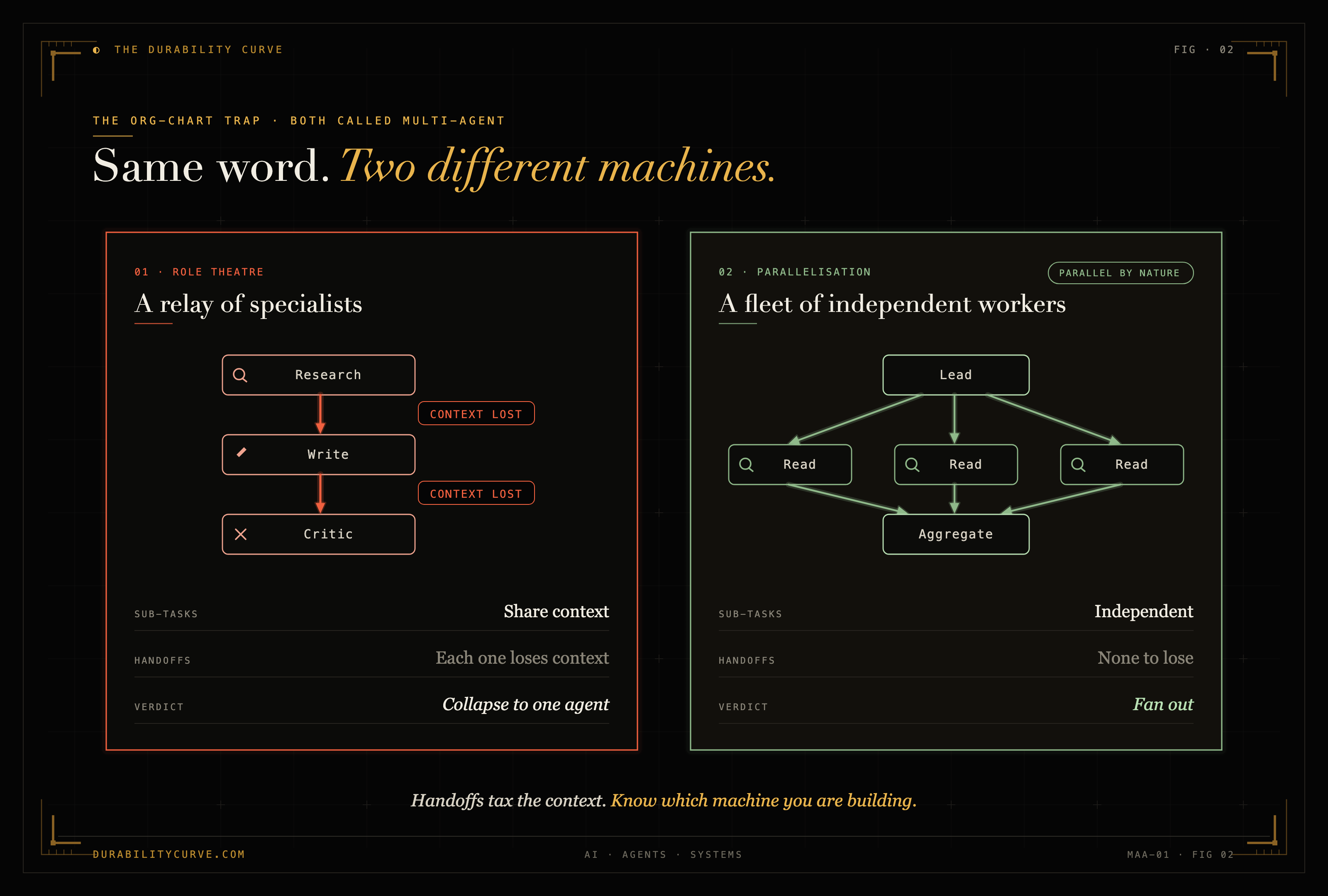
Put the two findings next to each other. Cognition builds coding agents, where the pieces are densely coupled. Anthropic built a research agent, where the pieces are separate look-ups. Each drew the right conclusion for the shape of problem in front of them.
The shape that decides it is whether the pieces carry decisions that depend on each other.
Ask a research system to find every board member across the Information Technology companies in the S&P 500. That is a hundred look-ups, and not one of them needs to know what the others found. Each sub-agent decides nothing the others have to honour, and the lead just collects the answers as they land. Now look again at the Flappy Bird job, even with the full task handed to every agent. The background, the bird, the pipes still have to agree on a style, a scale, and a feel that live in the whole and nowhere in the parts. Each agent makes those choices on its own, and independent choices about one shared thing drift apart. That is why the full-context run still failed. Context was never the bottleneck. The coupling was.
This is also why reading is safe and writing is dangerous. A read commits nothing, so ten agents can read the same material at once and never collide. A write commits a decision the others now have to stay consistent with, and nothing keeps them consistent once they cannot see each other. Read versus write is the fastest proxy for the real question: does this piece make a choice the other pieces depend on?
None of this is new. Readers may share and writers must take turns is the oldest rule in concurrent systems, the one behind every database lock and every thread that ever corrupted shared state. What is new is the layer it now governs. The rule has climbed from bytes in memory to decisions between agents, and the reason it keeps reappearing is that it was never about computers. It is about what happens when separate workers commit to the same thing without watching each other.
Count the decisions, not the agents
This is why the agent count on the box tells you nothing. A swarm of three hundred is not more capable than one agent by virtue of being three hundred. Agent count is cheap to inflate and easy to sell, and the moment it becomes the headline it stops tracking whether the work got done. The thing to measure is the decomposition, and the decomposition is measured in dependent decisions, not in boxes on a diagram.
The proxy has edges, and they are worth knowing, because the surface can mislead. Two research agents that only read can still collide if the task is vague enough that each has to decide what it means; that hidden interpretive choice is the coupling, even with no writes anywhere. And some jobs that look coupled are not: a body of text too large for one agent to hold at once, split across many readers, runs in parallel without conflict, because every reader shares the same goal but none constrains another’s finding. What settles the case is never how the task looks from a distance. It is whether finishing one piece requires knowing what another piece decided.
The bill you pay to be wrong
Even when fan-out is right, it is not free. Anthropic found that raw token usage alone explained about 80% of the variance on one of their browsing benchmarks, which is another way of saying the gain came mostly from spending more compute, not from clever coordination. An independent 2026 study across the Qwen, DeepSeek, and Gemini models reached the same verdict from the other side: on multi-step reasoning, hold the token budget equal and a single agent matches or beats the multi-agent setup, because the reported gains track compute, not architecture. 3 Their multi-agent system burns roughly fifteen times the tokens of a normal chat. Cheaper inference lowers what each token costs, not how many the architecture spends; fifteen times as many is fifteen times as many at any price. The absolute bill falls with the market. The multiple does not, and neither does the coupling you would be paying it for.
That multiple is the honest test of the whole decision. Fifteen times the cost is worth paying only when the task is valuable enough to earn it and parallel enough to use it. Point the same architecture at a coupled job and you pay the fifteen-times bill to manufacture the Flappy Bird problem at scale, and the cost can climb higher without warning, because a sub-agent that spawns its own sub-agents, or a tool that returns a wall of text, multiplies the spend again, and most builds have no cap that stops it. 4 If you cannot say in one sentence why the parallelism pays for itself here, you are paying the coordination tax and calling it a team. The same instinct shows up one layer down, in the pull to add more tools and more layers to a single agent until it is too complicated to debug, which is the trap the most powerful tools quietly set.
The machine most builds actually want
The argument is usually staged as swarm versus single agent, and that staging hides the machine you almost always want, which is neither pole. One strong agent, wrapped in an engineering envelope.
The envelope is plain engineering, and it is where the reliability lives. In practice it looks less like a team meeting and more like one skilled worker with good tools, a checklist, and a reviewer. A planner lays out the work before it starts, routes the cheap steps to cheaper models, and caches and retries so nothing is paid for or crashed twice. A supervisor then compares what the agent meant to do against what it did, and a separate pass checks the output against something outside the agent’s own judgement. You keep most of what the orchestration promised at a fraction of the token cost, and you never split one judgement across personas that cannot see each other. It is the same case as building the harness around the model instead of swapping the model: the structure around one strong agent does more of the work than the agent count ever will.
Fan-out still has a safe home inside this envelope, and it is read-only work. Claude Code’s investigation sub-agents are the clean example. They explore a codebase, answer a question, and hand a summary back to the single agent holding the thread, without touching a file. 5 Reading many things at once is parallel by nature. The moment you let sub-agents write in parallel, each committing changes the others cannot see, you have rebuilt the Flappy Bird problem inside your own codebase, which is exactly the risk in the newer parallel-coding setups. That one line, read or write, is the quickest filter you have, and it catches the common mistakes before they are built.
You do not have to take it on faith, because Cognition spent a year arriving at it themselves. Their 2026 follow-up, “Multi-Agents: What’s Actually Working,” is not a retraction of “Don’t Build Multi-Agents”; parallel-writer swarms are still out. What now runs in their production is the narrow class where writes stay single-threaded and the extra agents contribute intelligence rather than actions, and it is not theoretical: even in their most cautious enterprise segment, Devin usage is up roughly eightfold over six months. 6 A reviewer reads a diff and flags the bugs. A stronger model gets consulted on the hard call. A manager splits the read-heavy work, lets the children run, and keeps the one write to itself. The patterns they kept all have the same shape underneath: many readers, one writer. Read versus write, named from the inside by the team that opened the argument against multi-agents.
The test to run before you build
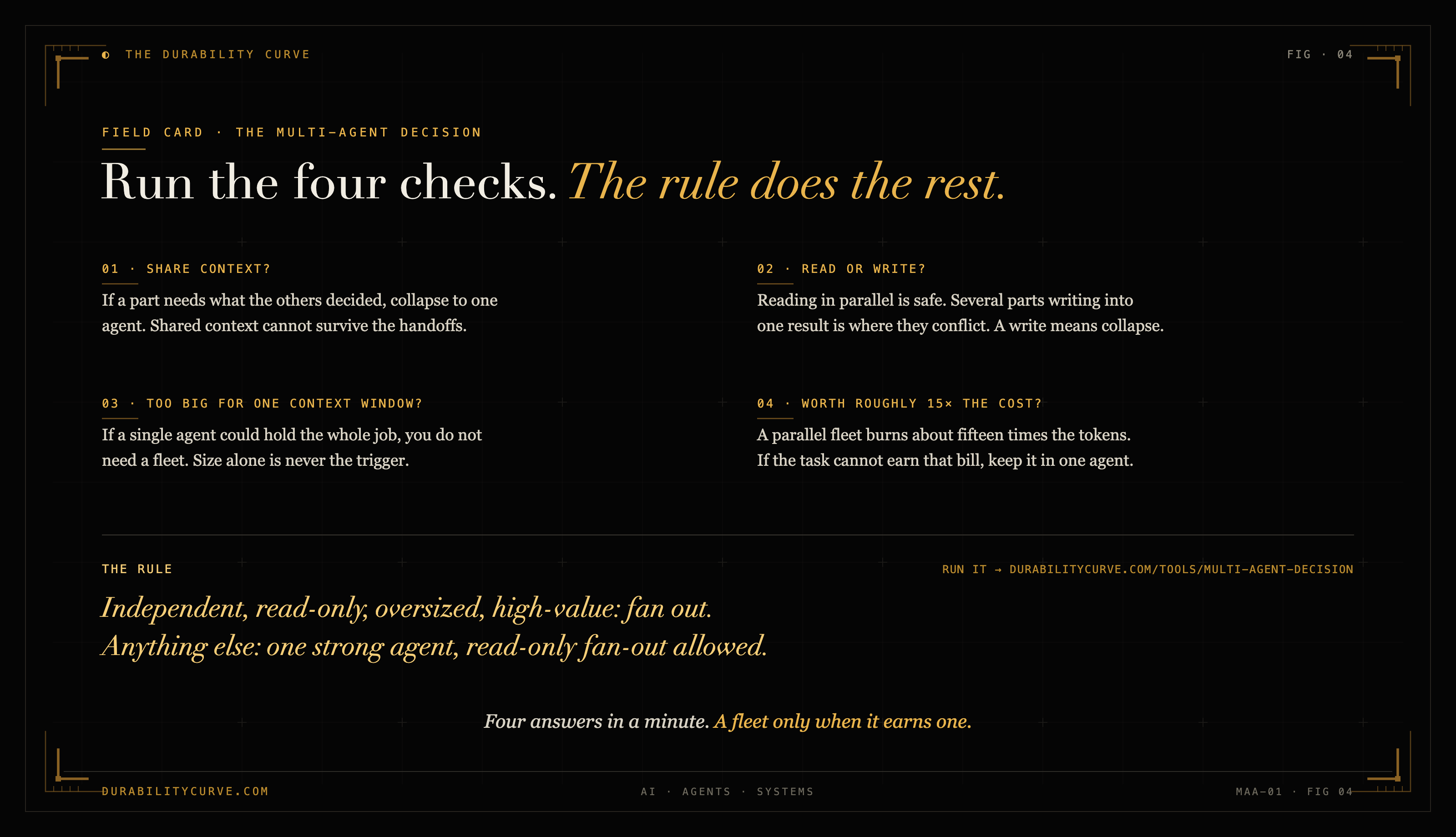
Before you stand up a multi-agent system, put the task through one check. Try to break the job into pieces, and for each piece ask four things. Can it be finished without knowing what the other pieces decided? Does it only read and report, or does it write into a shared result? Is the whole job too big for a single context window, more than one agent can hold in mind at once? And is it worth roughly fifteen times the cost of doing it plainly?
Independent, read-only, oversized, and high-value: fan it out, aggregate cheaply, and keep yourself at the question going in and the decision coming out. Anything else: collapse it back to one strong agent and spend your effort on the envelope. And if you cannot tell which case you are in, that uncertainty is the answer for now, because the coordination tax is real and the simpler machine should be the default.
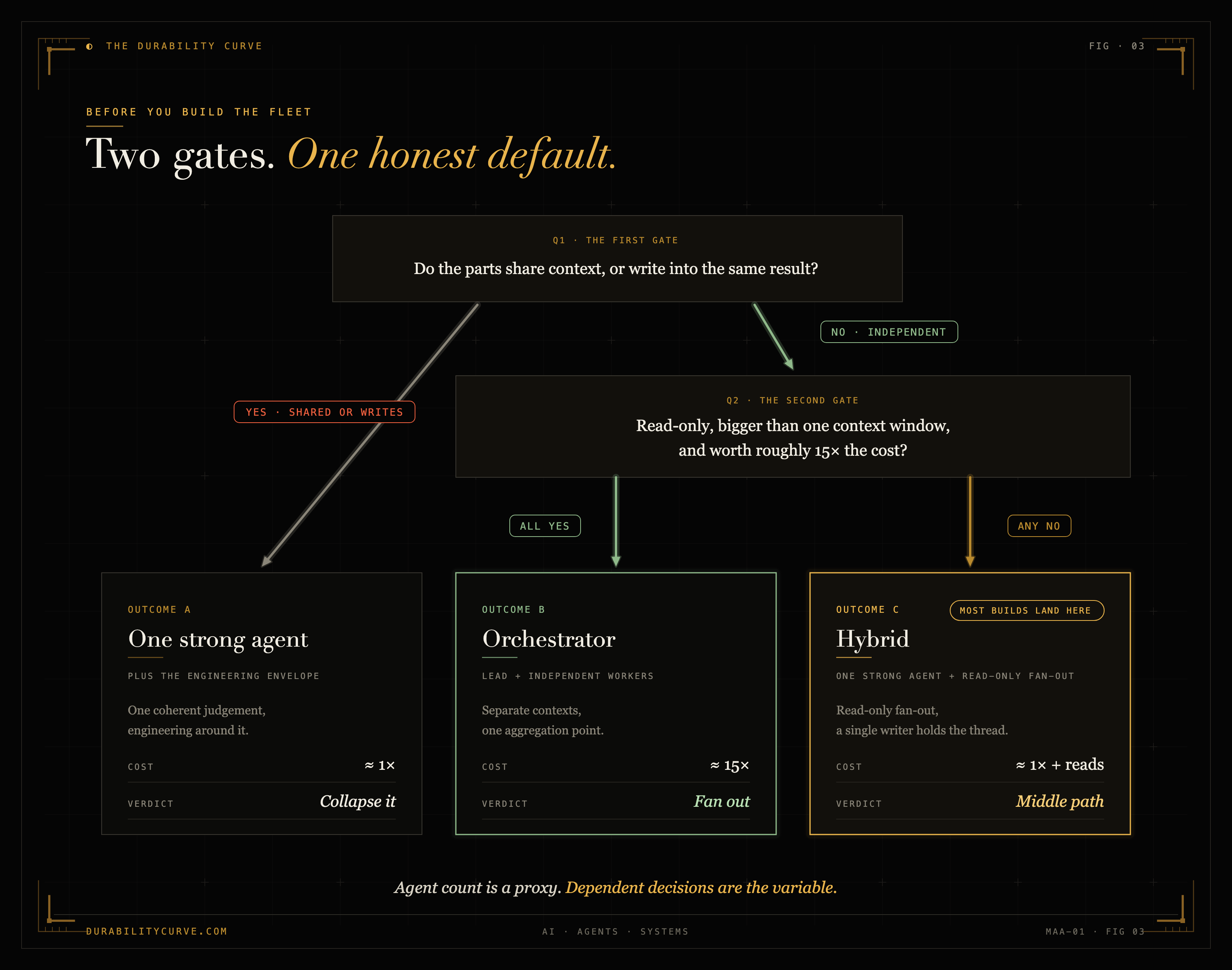
The four questions are the whole method, and you can run them on the back of a ticket.
When you want a specific task computed rather than eyeballed, I put the same checks into a small tool that returns the architecture and the rough cost.
So the next time someone proposes a designer agent, a coder agent, and a critic agent for one coherent job, ask the only question that decides it. Was the work ever actually separate? Most of the time you have drawn an org chart in software, and the org chart was the bug.
What is one task you split across agents, or were about to, and does it survive the read-versus-write test?
Walden Yan, "Don't Build Multi-Agents," Cognition (2025). Source of the Flappy Bird example, the two principles, and the fragility quote.
"How we built our multi-agent research system," Anthropic Engineering (13 June 2025). Source of the 90.2% internal-eval result, the 80%-of-variance finding on the BrowseComp benchmark, the ~15× token figure, and the point that shared-context and coding tasks are a poor fit for multi-agent.
Dat Tran and Douwe Kiela, "Single-Agent LLMs Outperform Multi-Agent Systems on Multi-Hop Reasoning Under Equal Thinking Token Budgets," arXiv (April 2026), an independent study across Qwen3, DeepSeek-R1-Distill-Llama, and Gemini 2.5. Single-agent systems "consistently match or outperform" multi-agent ones on multi-hop reasoning at equal token budgets, with the reported gains attributed to "unaccounted computation and context effects rather than inherent architectural benefits."
The 15× is Anthropic's own baseline. The further escalation is my own inference from the same system, which reports early failures like one agent "spawning 50 subagents for simple queries" and sets no per-run cost cap. Not a figure Anthropic states.
Claude Code's investigation sub-agents (its Explore and Plan modes) run read-only, searching and summarising without editing files. It also supports implementation sub-agents and parallel "agent teams" that write in parallel, which is the coupled-write case this piece flags as fragile.
Walden Yan, "Multi-Agents: What's Actually Working," Cognition (22 April 2026), the follow-up to "Don't Build Multi-Agents." Parallel-writer swarms are still out; what works now is "setups where multiple agents contribute intelligence to a task while writes stay single-threaded." The eightfold growth is Cognition's own figure for Devin in its largest enterprise segment; the three named patterns are the Code-Review-Loop, the "Smart Friend," and "map-reduce-and-manage" delegation.
The org chart framing is right. Most multi-agent setups I’ve built failed for the same reason real orgs do, too many handoffs and nobody owning the outcome. Half the time one strong agent with good tools beats five specialists playing telephone. Coordination is the tax nobody budgets for.
Both labs are right. Neither names the structural reason.
Each new agent is an authority surface. An agent that can generate, evaluate its own generation, pass the result forward, and act on it has collapsed four operations into one entity: propose, decide, promote, execute. That is authority collapse. One agent with authority collapse is one ungoverned surface. Five agents with authority collapse is five ungoverned surfaces. The coordination tax you name IS the governance cost of multiple ungoverned authorities trying to agree.
Cognition found multi-agent fragile because each agent was ungoverned. Anthropic found multi-agent productive because their research agents were read-only: they add intelligence, not actions. A read-only agent has no execute authority. A read-only agent cannot act on its own output. A read-only agent has no authority surface. That is why Anthropic's worked and Cognition's broke. Not task decomposability. Authority scope.
The question is not whether the task is decomposable into independent subtasks. The question is whether each sub-agent has authority separation. Can the agent that proposes also decide? Can the agent that decides also execute? If yes, that agent is an ungoverned authority surface. Add five of those and you have five points where the system can approve its own output, promote its own work, and act without external governance. The org chart is not the problem. The org chart without authority separation is the problem.
I built a protocol for this. Repo-native governance where the agent that generates cannot approve, the agent that checks cannot redefine criteria, and the governance lives in the repository, not in the agent's self-evaluation. Works for one agent. Works for five. The governance scales because the governance is structural, not coordinative.
https://metacortexdynamics.substack.com/p/stop-letting-ai-coding-agents-decide